

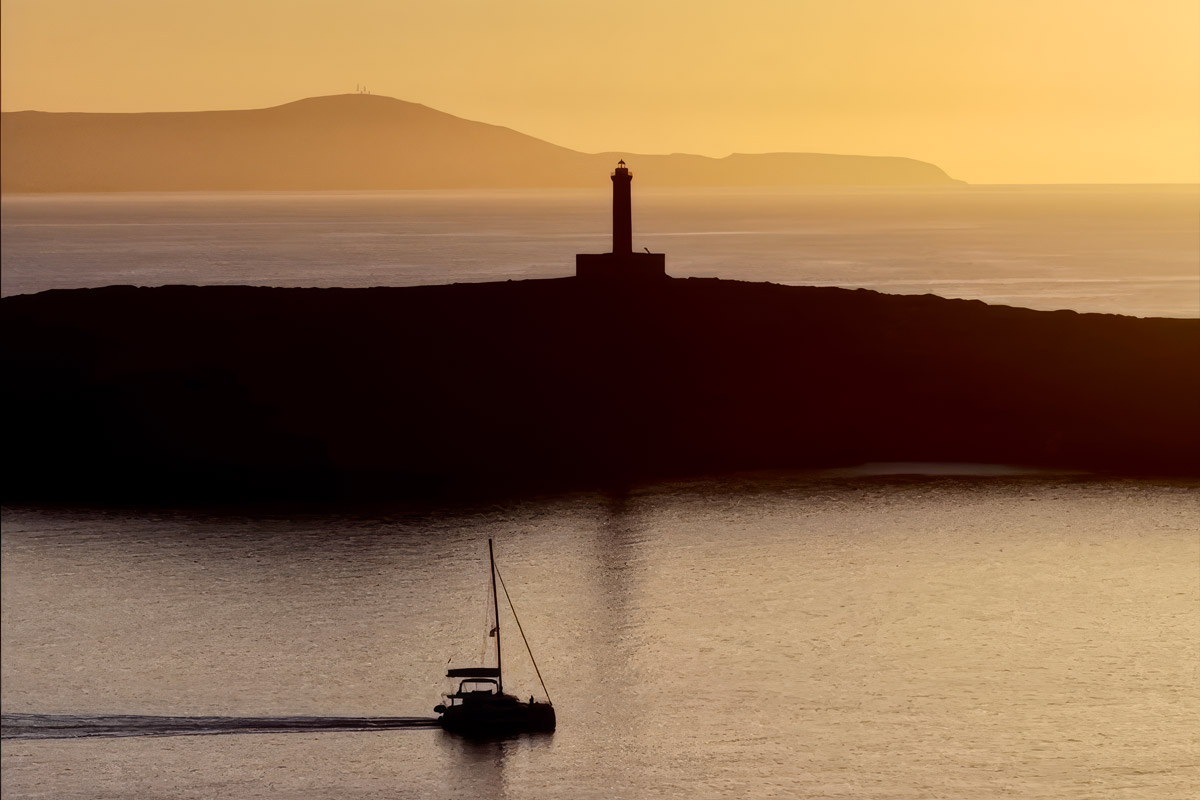
By the middle of September, Syros exhales. The ferries thin. Tables in Miaouli Square empty before midnight, and Ermoupoli belongs once again to the people who live in it. Yet this quiet month is exactly when next summer begins to take its shape. Villa owners open their calendars. Skippers commit their boats for the season. Quietly, without any announcement, the island starts filling a summer that most travellers have not begun to imagine.
That gap between two calendars, the island’s and the visitor’s, explains almost everything about how a summer here turns out.
The island works on a longer calendar than its guests
Syros is not large, and the addresses worth having are genuinely few. There is no endless inventory of villas above the sea, no fleet of good boats waiting in Ermoupoli, no long list of tables with a view worth crossing the island for. Instead there is a small, finite set of very good things, held by people who have been doing this for a long time.
Because the set is small, it moves quickly. A house in Delagrazia with the right orientation and the right terrace is spoken for by February. So is the skipper who actually knows where to anchor when the wind turns north. Meanwhile, the traveller who begins in April is not choosing. They are taking what is left.
This is the part that surprises people. Syros is not a difficult island to reach, and it never feels crowded in the way that its neighbours can. Still, its best things are scarce, and scarcity always rewards the early.
What is settled first, and in what order
A summer here assembles itself in a sequence, and the sequence matters more than the speed.
The house comes first, always. Everything else arranges itself around where you sleep, because on Syros the distance between the north and the south is a genuine decision, not a detail. A villa above Kini gives you sunsets and a fifteen minute drive into town. A house in Vaporia gives you the sea beneath your window and the town on your doorstep, but a different kind of quiet. Once that is settled, the shape of the whole visit follows.
Boats come second. The northern coast and the beaches that no road reaches depend entirely on a good skipper and a boat that suits your group, as the guide to the wild coast sets out. There are not many of either, and the good ones are committed by spring.
Tables come third, and later than most people expect. Reservations for the serious kitchens open closer to the season, yet the island’s best evenings are not simply booked. Someone arranges them, in the right week, with the right people, at the right hour.
After that come the things travellers assume are easy and rarely are. A private chef who cooks well for eight people in a villa kitchen he has never seen. A photographer who can work at six in the morning without making anyone feel photographed. Transfers that meet a delayed ferry at one in the morning without a phone call. None of these are difficult to arrange in February. All of them become a problem in June.
Why early is not the same as rushed
There is a version of early planning that feels like pressure, and we have no interest in it. Deposits taken quickly, itineraries filled before anyone has thought, a schedule that leaves no room for a morning that goes differently than expected. That is not planning. That is inventory management.
The version we practise is slower and considerably calmer. It begins with a conversation about what you actually want from the days, not a list of what is available. Only afterwards do we start holding the things that will make those days possible.
The paradox is that beginning early is what makes a relaxed stay possible at all. When the house, the boat and the two or three evenings that matter are settled by winter, the rest of the visit can stay genuinely open. You arrive with structure underneath you and nothing scheduled on top of it. That freedom is expensive to buy in June and almost free in October.
What a good autumn conversation actually covers
Planning a trip to Syros properly does not require you to decide very much at this stage. It requires you to decide a few things well.
The first is the week. Every part of the summer here has a different character. July brings the International Festival of the Aegeanto the Apollon Theatre, and the town keeps late hours. August belongs partly to Greek families, which is a pleasure if you understand it and a surprise if you do not. Early June and late September give you the island at its most open, with the sea already warm.
The second is the shape of the group. Two people, a family with young children and six friends travelling together are three entirely different logistical problems, and they call for different houses in different parts of the island.
The third is the level of involvement you want from us. Some guests want everything held quietly in the background. Others want to be shown options and to choose. Both work, but the answer changes how we build the stay.
The advantage that compounds
There is one more reason to begin now, and it has little to do with availability. When we hold a stay for eight or nine months, there is time to do the work properly. Winter shows us how a villa really behaves, which no photograph ever will. A chef will talk to you in January in a way he simply cannot in July. Two dates for a boat can sit quietly reserved until your plans firm up, and then one goes back. Above all, we learn what you actually enjoy, slowly, through a handful of unhurried exchanges rather than a rush of messages in June.
There is a second, quieter benefit. Guests who begin early tend to arrive already knowing something about the island. By March they have a sense of why Ano Syros feels older than everything beneath it, why the north is worth the drive, which evening they are most looking forward to. The anticipation becomes part of the stay rather than a nervous countdown to it. Few things improve a week more than arriving somewhere you have already begun to understand.
That is the real difference between a trip that is booked and a stay that is composed. The first is a set of confirmations. The second is a set of decisions made by people who understood the question.
Syros rewards this kind of attention more than most islands do, because it does not perform for visitors. It is a working town of twenty one thousand people, an administrative capital with a marble square and an opera house, and it opens according to how well you know it. If you would like a sense of the place before you decide, the official Greek tourism organisation’s walk through Ermoupoli is an honest introduction to the town itself.
Where to begin
Planning a trip to Syros for next summer starts with a single conversation, usually twenty minutes long, usually in autumn or early winter. We ask what kind of days you have in mind. We tell you honestly what is possible in the week you are considering, and what is not. From there, we build the stay.
You can see how we coordinate a stay before you write to us. When you are ready, we are here, and the calendar is still open.