

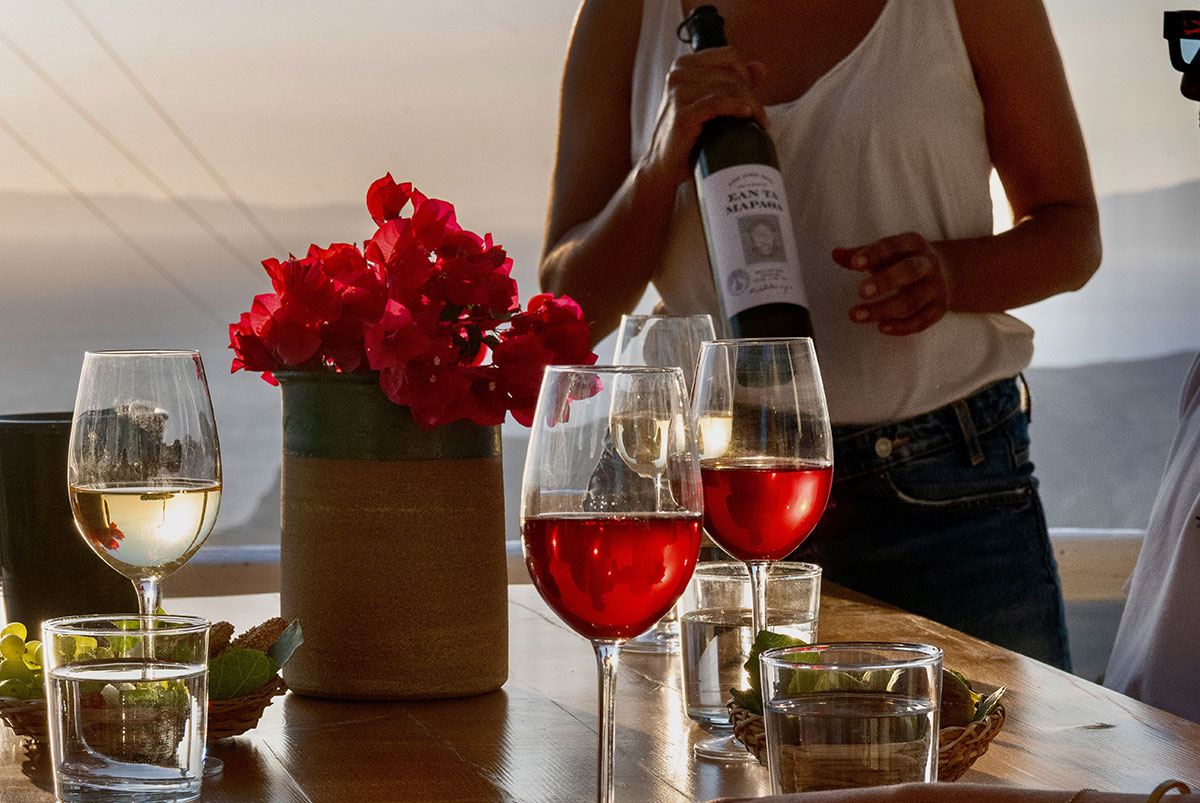
There is a grape that grows on this island and almost nowhere else. It is called Serifiotiko, and the wine it makes is bone dry, mineral, and faintly salty, as if the sea wind had got into the glass. You will not find it on supermarket shelves abroad. Most of it never leaves the island at all. That, in a single bottle, is the story of wine on Syros.
This is not Santorini, with its famous vines and its busloads of tasters. Syros makes wine the way it does most things, quietly, for itself, by people who have farmed the same terraces for generations. For a traveler who cares about what is real, that is exactly the appeal.
A vineyard older than memory
The wine heart of the island is Apano Meria, the wild northern half, a protected landscape of drystone terraces, scattered farmhouses, and the scent of thyme and fennel on the wind. Vines have grown on these slopes for centuries, climbing the hillsides in narrow steps cut from the rock.
The conditions are harsh, and the harshness is the point. The land is dry, stony and sun blasted, swept all summer by the Meltemi, the strong northerly wind that keeps the vines healthy and pushes the grapes toward a piercing, saline character. In the sandy soils near the sea, some vines still grow on their own roots, ungrafted, a living link to a way of farming that has almost vanished from Europe. From this difficult ground come the island’s wines: crisp and salty whites, pale structured rosés, light reds, and a handful of amber, skin-contact bottles that are quietly becoming the island’s signature.
The grape that belongs here
Serifiotiko is the soul of Syros wine. It is a rare Cycladic white, and its name carries a small mystery, since it points to the neighboring island of Serifos. Both islands claim it, and the truth is that it is an old Aegean variety grown across these waters for generations. What matters is that on Syros it has found its home, and it makes the island’s defining white: dry, mineral, citrus and stone fruit, with that thread of salt running through.
Around it grow other island grapes. Fokiano, hardy and drought-resistant, becomes a fruity rosé. Monemvasia, descended from the Malvasia the Venetians prized, makes rounded whites. Even Assyrtiko, the great grape of the Cyclades, takes on a lighter, brighter expression here than it does on its famous neighbor. Each one tells you something about the land it came from.
The wineries themselves
The wineries of Syros are small, family run, and almost all best visited by appointment. There are four worth knowing, and each offers a different window into the island.
OuSyra, in the southern village of Chroussa, is the organic heart of the island’s wine revival. Founded by a sommelier who spent his childhood summers here, it works with rare ungrafted vines and makes a varietal Serifiotiko of real character, austere and saline and powerful, tasted among the vines themselves.
Chatzakis Winery, now in the northern hills near San Michalis, is the work of an oenologist who began the modern revival back in 2011, and offers the broadest range, from a citrussy Assyrtiko to an orange Serifiotiko.
Parakopois, at the foot of Gerousi hill, is run by a third-generation farmer and his partner, with vines over fifty years old growing on their own roots. Their tasting, set in an outdoor space overlooking the vineyards, is the most welcoming on the island.
And Freris, in Pagos, carries a family vineyard a century old into the present, with what are said to be the island’s first certified organic labels.
Where to taste in town
You do not have to leave Ermoupoli to find good Syros wine. The marble town has its own quiet wine culture, tucked into its old market lanes.
On a narrow alley off the market sits what is officially the smallest wine bar in Greece, a former barbershop turned into a jewel box of a room, pouring a thoughtful list with a strong focus on Greek producers and small plates to match. A few streets away is the oldest wine cellar in the country, founded in 1917 and still run by the same family, as much a cultural institution as a shop, and the right place to buy a few bottles to carry home. The island’s best tables, from a creative kitchen in a courtyard off the main square to the fine dining rooms of the town and the hill, all keep local wines on their lists.
The table that completes the glass
Syros wine was made to be drunk with Syros food, and the pairing is one of the great pleasures of the island.
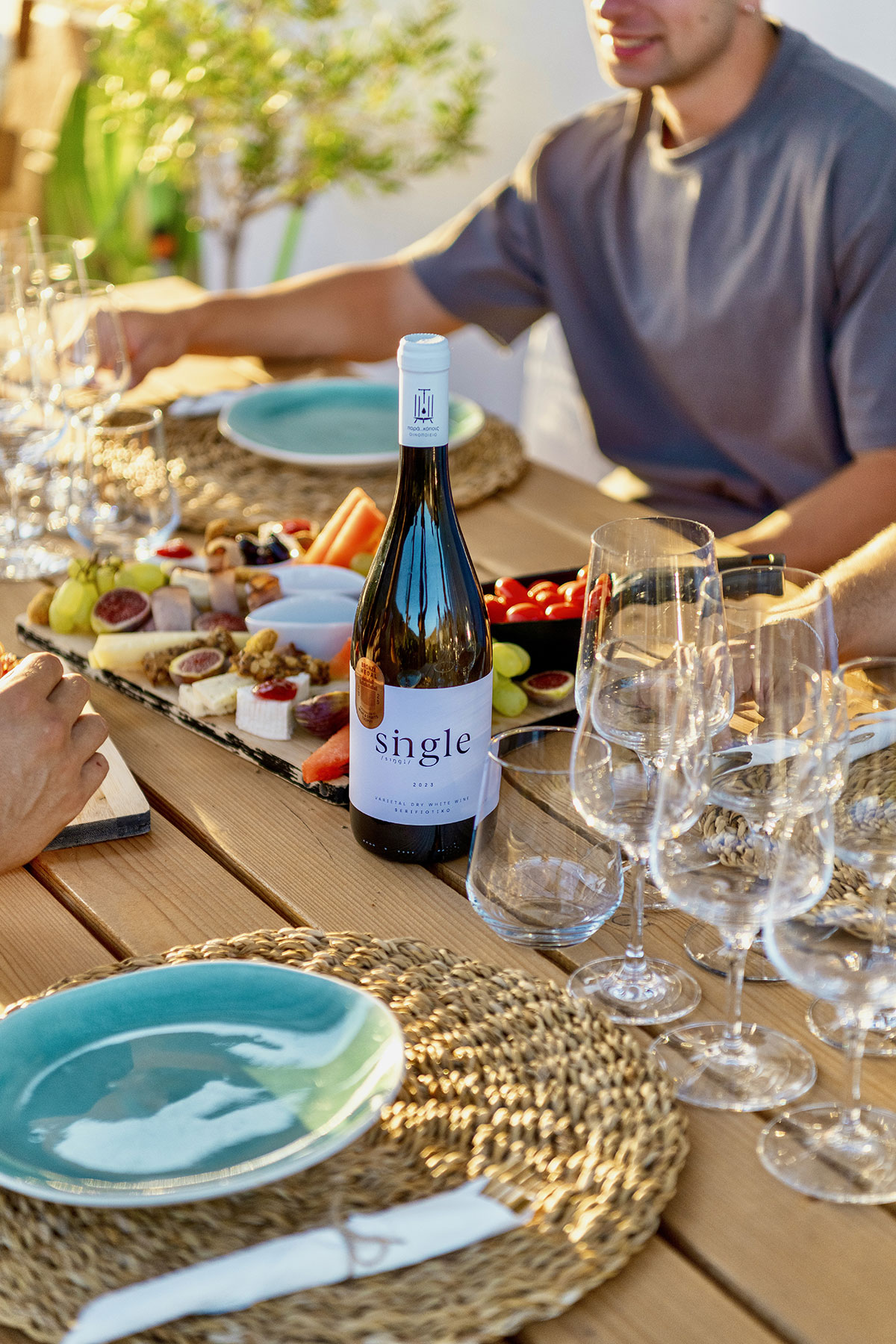
San Michali, the island’s own hard cheese and the only one of its kind in Greece, is nutty and sharp and matured for months on the milk of cattle grazing the herb-covered north. It meets a saline Serifiotiko perfectly. So does louza, the cured pork loin marinated in red wine and spice, and kopanisti, the soft peppery cheese spread on barley rusks. Add capers from the dry hills, fresh fish from the harbor, and you have a table that explains the wine better than any tasting note could.
How to drink Syros properly
Because the producers are tiny and open by appointment, the island rewards planning rather than wandering. The pleasure here is not a tasting-room conveyor belt. It is a private hour with the winemaker among the vines, a glass of ungrafted Serifiotiko where the grapes actually grow, a tasting paired with the island’s own cheese and cured meat, an unhurried afternoon that moves from the northern terraces to a southern hillside to a quiet wine bar in town as the light softens.
That is the kind of day that does not assemble itself. The appointments, the timing, the transfers between north and south, the right table to end on, all of it takes someone who knows the island and the people who make its wine. Arranged properly, a day among the wineries of Syros becomes one of the most memorable parts of a stay, a way of tasting the land itself.
Most of this wine never leaves the island. The only way to know it is to come, and to drink it where it was made.