

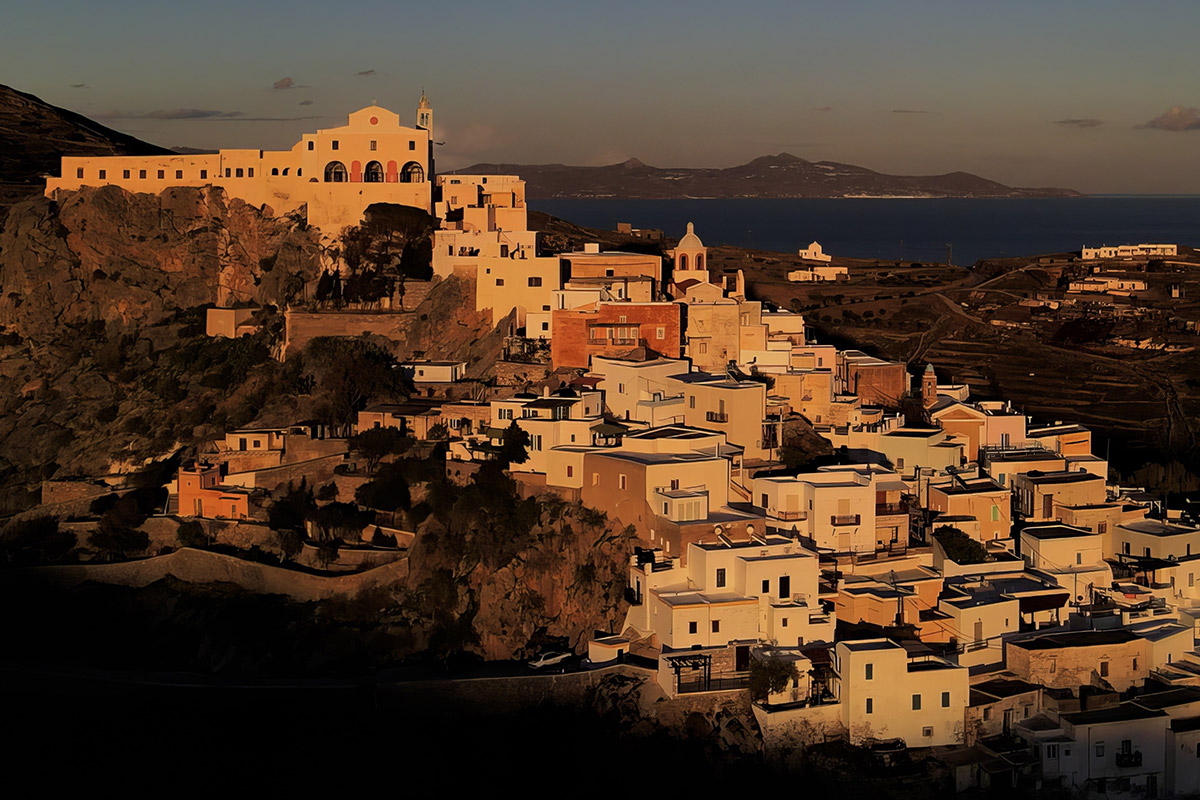
There is a difference between a place you visit and a place that teaches you how to think. Ano Syros is the second kind.
It sits 188 metres above the port, on the hill of San Giorgio. From below it looks like a Venetian fortress arranged in concentric circles, which is precisely what it is.
Built around 1200 after the Fourth Crusade, designed to resist pirate raids and Ottoman conversion, it remains inhabited by roughly 1,700 people who have chosen not to leave. They still close the five gates of their medieval settlement at night. Not in performance. In habit.
This is not a village frozen by tourism. This is a place where understanding requires climbing.
The grammar of arrival
You enter through Kamara, the main gate. The lanes immediately narrow. There are no straight lines. Houses share walls. The streets spiral inward toward two focal points: the Cathedral of Agios Georgios at the summit, and the Piatsa at the centre, where the white-painted line in the cobbles marks the path that locals have walked for centuries.
The logic is medieval and still makes sense. Narrow lanes meant fewer angles to defend. Shared walls meant warmth in winter and protection from wind. The spiral meant confusion for anyone trying to invade. Even now, standing in the Piatsa—the island’s only piazza in the Italian sense—you feel the intentionality. This square was not designed for crowds. It was designed for people who belonged here.
The Cathedral of Agios Georgios rises from the highest point. The original sanctuary dates to the early 13th century, built on a succession of sites going back to Byzantine times. The present three-aisled basilica with marble columns was rebuilt in 1834, after Ottoman destruction in 1617 when the Catholic bishop was martyred for refusing conversion. The bell tower, completed in 1855, rose higher than the walls of Ermoupoli below—a deliberate signal. We are still here. We are still Catholic. We still remember.
Inside hangs an organ built in Italy in 1888, donated by Pope Leo XIII to Athens, transferred to Syros in 1951, and fully restored in 2019. The organ is the oldest functioning pipe organ in Greece. In summer, the ANO International Organ Festival fills the cathedral with Bach and contemporary composers. That too is a kind of memory.
The spiritual layer
Ano Syros is the seat of the Catholic Diocese of Syros and Milos. This matters. It means the island has never been exclusively Orthodox. It means two communities—Catholic and Orthodox—have lived in deliberate proximity for eight centuries. It means the Feast of Saint George, the liturgical calendar, the midnight services at Easter, the processions from both faiths converging at the town hall—all of this is native to the island’s rhythm, not imported tourism.
The Capuchin friars arrived in 1633 and took over the church of Agios Ioannis in 1639. Beneath that church are crypts where Catholic families sheltered from raids. Their tombs are still there. A library of 6,000 old manuscripts remains. The monastery is no longer populous—the friars are in their eighties now—but it functions as a living archive, not a museum.
Up the spiral of steps, the Jesuit Monastery of 1744 houses the church of Panagia Karmilou. It is barely open. But its existence means something: that even when empires changed, even when Napoleon conquered and the Ottomans ruled and modernity arrived, these communities stayed. They prayed. They kept books. They gave names to buildings and asked younger people to remember.
That is what Ano Syros remembers, every morning and every evening.

The piazza and the evening
The Piatsa is where the settlement thinks about itself. Markos Vamvakaris, the patriarch of rebetiko music, was born here in 1905. His bust stands in the square. His museum is three doors away—shoes, manuscripts, his ID, his coffee cup. The Rebetiko Festival “Syra of Markos Vamvakaris” gathers each August under the auspices of the Greek Ministry of Culture. That is also a form of remembering.
For dinner, Hygge has arrived as the settlement’s most serious kitchen. The restaurant opened in 2022 and operates April through October, with a kitchen that works with few, clean ingredients—taramas with coriander oil, fish of the day with cheese from the Cyclades, lamb shank, a notable tiramisu. The dining room and terrace face directly toward Ermoupoli and the harbour. From the table, you can see the Orthodox church dome of Vrontado across the valley. That visual conversation—Catholic hill facing Orthodox hill—is the island’s actual story.
For after-dinner conversation, there is Theosis. The bar opened in summer 2021 in an 1850 building at the heart of the Piatsa. It is not decorated like a nightclub. It is designed as an exercise in philosophy. The cocktails have names from Plato: Eros, Apatheia, Hedone, Catharsis. The glassware is all custom. The lighting is intentional. Every element, from the ceramics to the brand identity, was created by Natasa Polizou. The effect is that you are not in a bar. You are inside someone’s serious thinking about what Cycladic culture actually is.
Sit on the marble steps. Drink the cocktail slowly. Watch the light fade. The settlement quiets as the light dies. This is when you understand what the narrow lanes were for. They were for containing sound. For making silence possible. For keeping the noise of the world outside the walls.
Why Ano Syros teaches
Understanding a place and understanding a stay are not the same thing. But they begin in the same place: intention.
Ano Syros teaches because it never pretended to be anything else. It was built to survive. It was built to remember. It was built by people who understood that beauty is not decoration but the result of knowing what matters and building only that.
When you sit in the Cathedral terrace at dusk—and on clear nights Tinos, Delos, Mykonos and Naxos become visible at once—you are not looking at a view. You are looking at proof that people stayed. That they did not run when it became cheaper to live elsewhere. That they climbed this hill every morning and said their prayers and asked the light to remember them too.
That is what a curated stay in Syros must include. Not the spectacle. The depth.
If you are drawn to places like Ano Syros—places that remember—we help travelers organize stays shaped around that intelligence. Our coordination process is built for people who want to understand the island they are visiting, not simply consume it.