

Most Greek islands perform. They wake up in May, put on a show for the summer, and quietly close the curtain in October. The famous ones do this better than anyone. They are beautiful, and they know it, and the knowing is the problem.
Syros does not perform. It cannot, because it has somewhere to be.
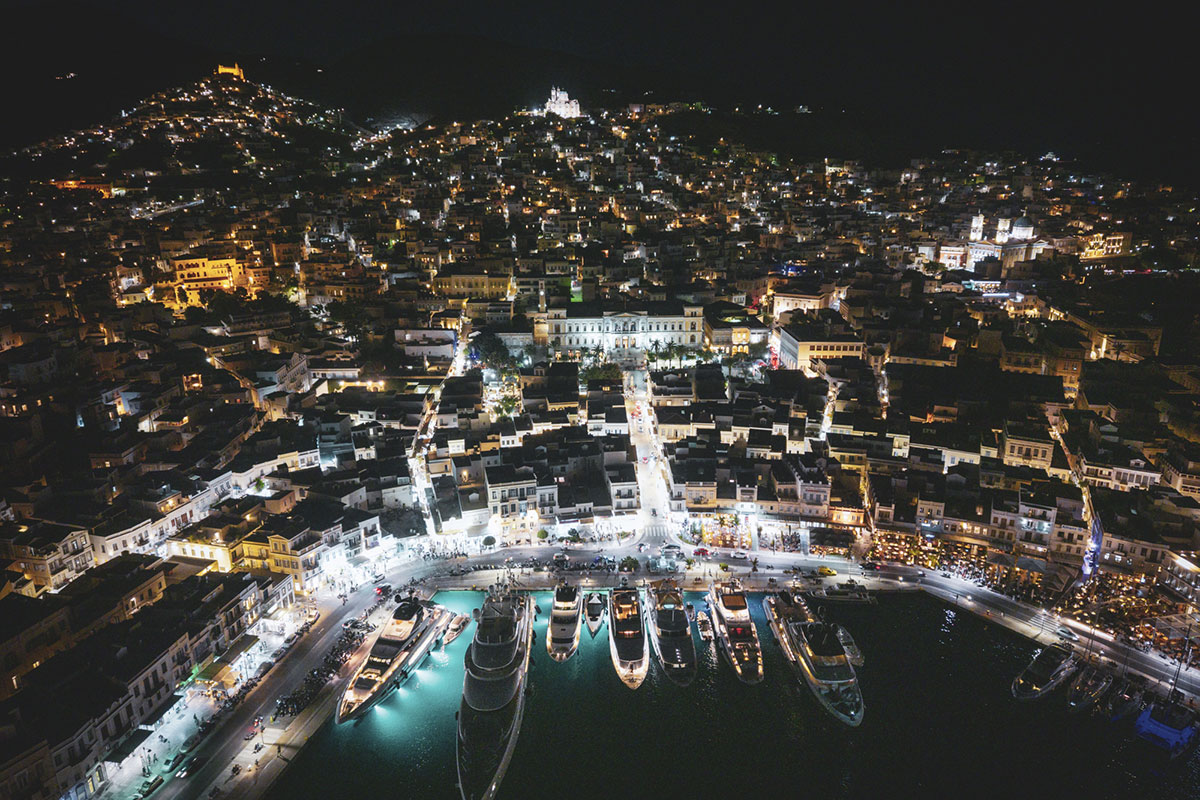
This is the first thing to understand about why Syros feels different the moment you arrive. While the postcard islands empty out each winter, Syros stays full. People live here. They work, raise families, run businesses, attend the university, argue in the cafés, and walk the marble squares in February when there is not a single tourist in sight. The island has a life that does not depend on you watching it. And that, paradoxically, is exactly why it is worth watching.
A capital, not a resort
Syros is the administrative capital of the entire Cyclades. The regional government of the South Aegean sits in Ermoupoli, along with the courts, the port authority, and the offices that run fifty inhabited islands. This is not a marketing line. It is the legal reality, and you feel it in the streets.
Walk the waterfront on a weekday morning and you see people doing actual business. Lawyers, civil servants, shipping agents, students, fishmongers. The town has a civic pulse that has nothing to do with tourism, because tourism was never the point. When a place has real work to do, it does not need to flatter its visitors. It simply gets on with being itself, and invites you to keep up.
The numbers tell the story plainly. Over 21,000 people live on Syros year-round. The South Aegean was the only region in Greece to grow its population in the last census. People are moving here, not leaving. That is rare for a Greek island, and it changes everything about how the place feels.
The first city of modern Greece
There is a deeper reason why Syros carries itself with such quiet confidence. Two hundred years ago, this was the most important city in the country.
Refugees fleeing the War of Independence founded Ermoupoli in the 1820s. They named it for Hermes, the god of commerce, and they built it into the leading port and the richest city of the new Greek state. Shipyards, textile mills, banks, the first opera house, the first high school, the first proper hospital. They called it the Manchester of the Aegean. Eleftherios Venizelos once said that Greece was reborn in Syros.
Then Piraeus rose, the Corinth Canal opened, and the commercial tide moved on. But here is the gift in that decline. Because the money left before the developers arrived, the nineteenth century never got knocked down. The neoclassical mansions still stand. The marble squares are still marble. The town that wealth built is still here, intact, slightly faded, and far more beautiful for it.
Proof that the island is alive
You can measure a place by what it makes. Syros still makes things.
The Neorion shipyard, one of the oldest in Greece, is still working. It employs around five hundred people and completes dozens of ship repairs every year. This is not a museum. It is a functioning industrial economy on a Cycladic island, which is almost a contradiction in terms, and yet there it is, welding and hammering by the harbour.
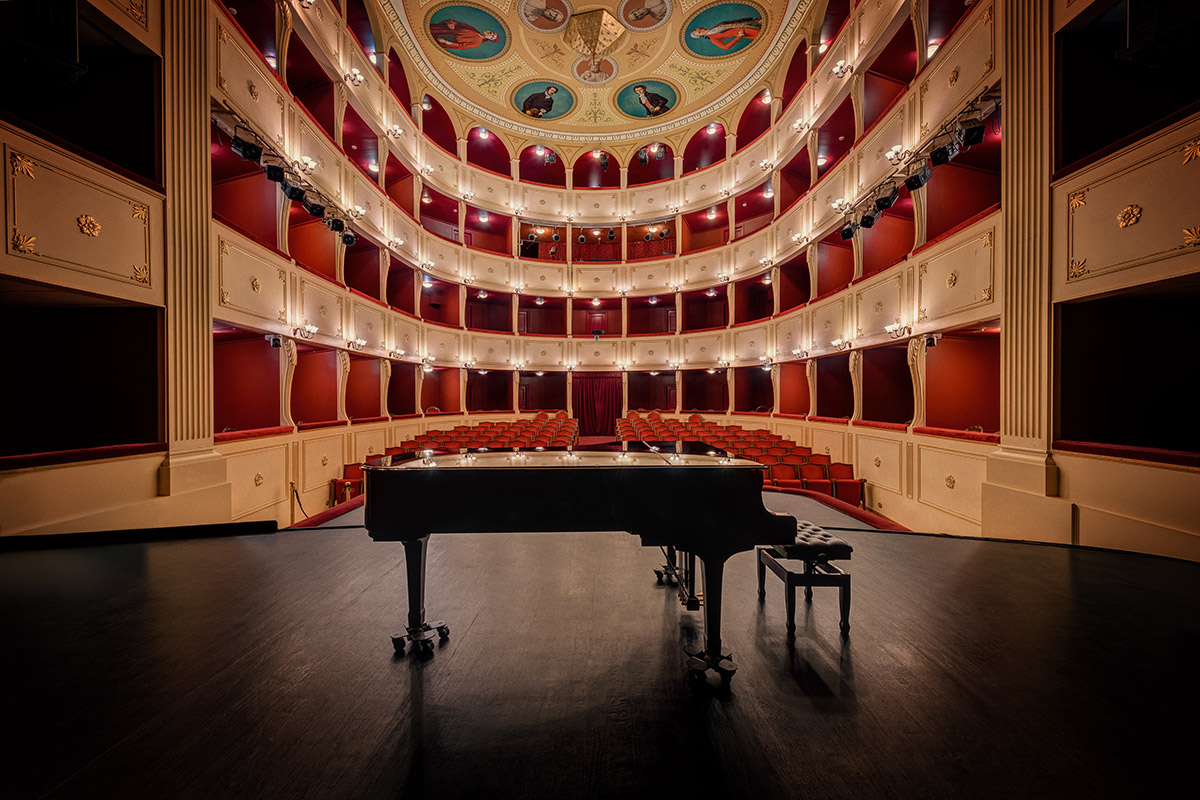
The culture is equally alive, and equally year-round. The Apollon Theatre, built in 1864 and modeled on the great Italian opera houses, still stages opera and theatre. The calendar fills with festivals: jazz, film, animation, chamber music, rebetiko, choral, guitar.
In a single year the island hosts more serious cultural events than islands ten times its fame. And in 2026, Ermoupoli celebrates its bicentenary, two hundred years since its founding, with more than a hundred events running from spring through autumn.
The island of two faiths
Climb the hill to Ano Syros, the medieval town founded by the Venetians eight centuries ago, and you reach a Catholic cathedral. Look across the valley and you see the Orthodox church on the opposite hill. Two faiths, two hills, one island, facing each other in conversation since the Middle Ages.
Syros is one of the very few places on earth where Catholics and Orthodox celebrate Easter on the same day. Centuries of coexistence and mixed marriages settled it. On the night of the Resurrection, the processions wind through the same streets, and the whole island, both faiths, marks the moment together. There is nothing else quite like it in Greece. It is the clearest proof that this island has always known how to hold more than one thing at once.
This dual identity also gave Greece something unexpected. Markos Vamvakaris, the patriarch of rebetiko, was born in Catholic Ano Syros in 1905. The most Greek of all musical traditions has its father in a Catholic boy from this island.
That is the kind of contradiction Syros specializes in.
What this means for a stay
So why Syros, and not one of the islands you already know? Because the famous ones give you what you expected, and Syros gives you what you did not.
It rewards attention. The traveler who walks slowly, eats the local San Michali cheese and the cured louza, sits in a café where the other tables are locals, climbs to Ano Syros at dusk, and lets the island reveal itself in its own time, that traveler leaves with something the postcard islands cannot offer. Not a photograph of a place, but the feeling of having understood one.
This is exactly the kind of stay we are built to shape. A place this layered does not unfold on its own. It takes someone who knows which evening to climb the hill, which table to book, which festival is worth rearranging your week for. That is the work we do, and it is why a structured stay here is less about ticking off sights and more about reading a place correctly.