

Rebetiko is not a song you listen to. It is a way of thinking about survival.
A man comes to the waterfront alone. He has lost something. He does not sing about what he lost. Instead, he circles it—slowly, deliberately—turning in place as if the turning itself might make the weight lighter. The dance is called the zeibekiko. The music is rebetiko. And on Syros in August, when the 10th International Rebetiko Festival “Syra of Markos Vamvakaris” arrives on the 26th, you understand that this island did not inherit this tradition from somewhere else. Rebetiko was born here.
The man and the bouzouki
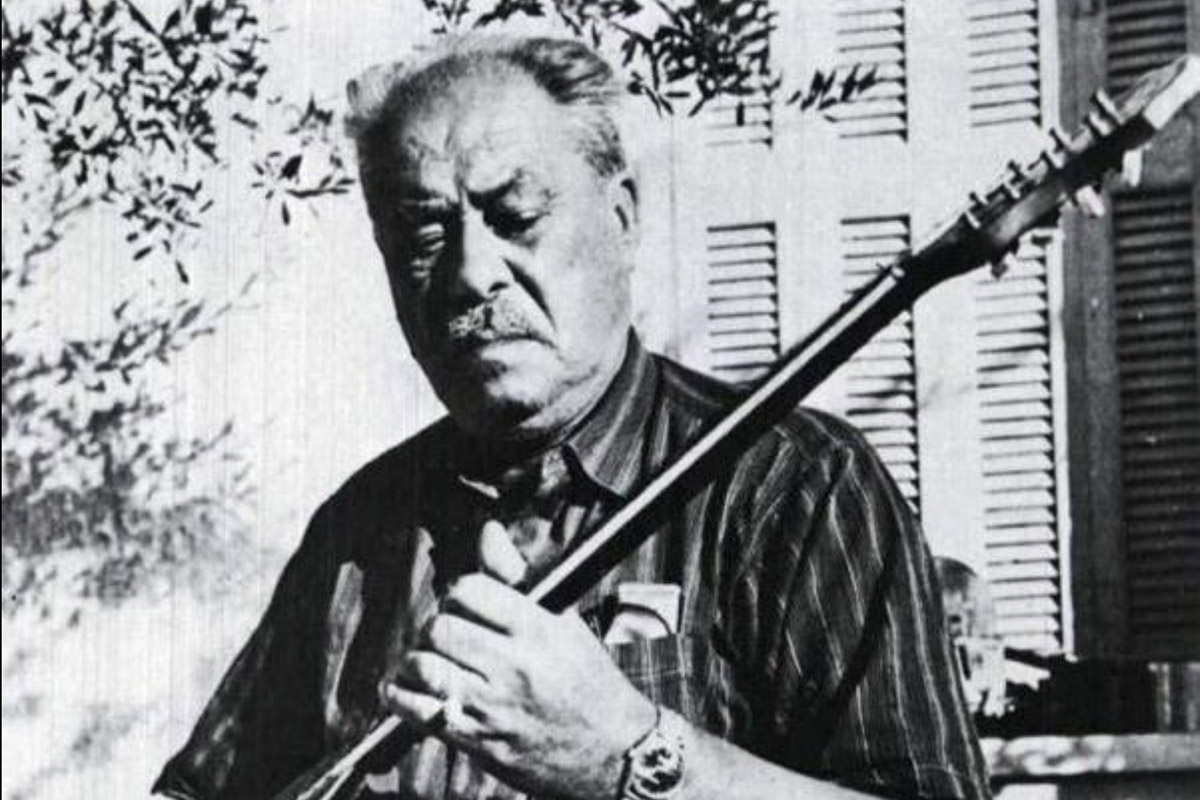
Markos Vamvakaris was born in Ano Syros on 10 May 1905, the son of a poor Catholic family. His father played the tsabouna—the Cycladic bagpipe. His mother was Elpida. The household was working-class and cramped. At twelve years old, convinced (falsely) that the police wanted him, he stowed away to Piraeus.
He worked as a stevedore, a pit-coal miner, a butcher in the public abattoirs. One night in 1917, he heard a bouzouki. By his own account, he promised himself he would cut off his own hand if he could not master the instrument within six months.
He learned. He recorded his first song in 1932. Within two years, he had formed the Piraeus Quartet with Giorgos Batis, Anestis Delias and Stratos Pagioumtzis—the ensemble that pulled rebetiko out of the tekedes (hashish dens) and onto the stages and records of the modern world.
His most famous song, Frangosyriani, was written in 1935 as a love letter to a Catholic girl from Syros. It names the island’s actual places: Foinikas, Pateli, Galissas. It is, at once, a love song and a real-estate tour.
Forty years later, he died in Nikaia, Piraeus on 8 February 1972. The state offered no honours.
Why rebetiko matters now
Rebetiko was recognised by UNESCO in 2017 as a living musical tradition with a strong symbolic, ideological and artistic character. This designation matters because it shifts how we think about the genre. Rebetiko is not folklore. It is not a historical artifact. It is a philosophy of dignity in the face of loss. The songs speak to exile, injustice, love that cannot be kept, the choice to endure rather than to complain. They were sung by stevedores and prisoners, by working women and refugees from Asia Minor. The zeibekiko dance—performed alone, introspectively, in 9/8 time—is the physical embodiment of this philosophy. The music addresses all people without discrimination.
Syros’s claim to rebetiko is precise. The island is where Catholic and Orthodox met after the 1922 Greco-Turkish War, when roughly 1.5 million refugees poured into Greece.
Many landed in Ermoupoli. The Vamvakaris family—Frankosyrians, as the local Catholics were known—had lived on the island for centuries. The intersection of these three things—Catholicism, refugee experience, and Cycladic maritime culture—made Syros a natural crucible for rebetiko. Markos did not import the tradition; he distilled what the island already was.
The season: August 2026
The 10th International Rebetiko Festival “Syra of Markos Vamvakaris” runs 26–29 August 2026. The festival holds the EFFE Label from the European Festivals Association and operates under the auspices of the Greek Ministry of Culture. Admission is free. Venues include Vamvakaris Square in Ano Syros—intimate, for solo singers—and the Tarsanas waterfront in Ermoupoli, where the main-stage performances run late into the night. The 9th edition in 2025 featured Chrysoula Kechagioglou, the Beraber ensemble, and performances exploring women in rebetiko.
The timing is deliberate. 2026 is Ermoupoli’s bicentenary year—two centuries since the city was named in 1826. The rebetiko festival sits inside that larger cultural arc, a reminder that the island’s identity is not separate from the tradition, but inseparable from it. To be in Ano Syros during the festival is to understand that the marble steps between Ermoupoli and Ano Syros are not merely a walk; they are a timeline. At the top is the 800-year-old Catholic settlement. At the bottom is the 200-year-old port city built by refugees. Between them—in the narrow lanes, in the bars, in the voices of singers—is rebetiko.
Where to listen
The Markos Vamvakaris Museum at Piatsa in Ano Syros, opened in 1995, holds his personal papers, shoes, watch, ring, and a 30-minute documentary. Hours are Tuesday to Sunday, 10:30–13:00 and 18:00–21:30 (April–October). Entry is €5. A short walk away, Stou Lili, the cellar taverna in Ano Syros, is where Markos Vamvakaris himself played in 1954 for a full year after his absence from the island. The taverna remains open, simple and unhurried. There is a bouzouki on the wall, available to whoever wants to play.
What a curated stay includes
Understanding rebetiko means understanding Syros differently. It means recognising that the island is not a postcard. It is a place where loss has been transformed into dignity, where exile has become home, where a poor boy from Ano Syros could become the patriarch of a musical tradition that now belongs to all of Greece. The genre emerged after the Asia Minor Catastrophe of 1922, when refugees from Smyrna, Aydın and Constantinople poured into Greece, bringing their musical traditions with them. Syros absorbed that legacy and made it its own.
A structured stay in Syros during rebetiko season is not about collecting experiences. It is about sitting still in the right places and letting the tradition teach you. Spend time at the museum. Eat simply at Stou Lili. Listen to Frangosyriani before you arrive and again after you leave. Attend the festival nights at Tarsanas and Vamvakaris Square. Drink a Catharsis at Theosis and understand, through the drink and the square and the music, why this island remembers.
If you are drawn to places where culture runs deeper than the surface, where the past is not museum-bound but living, we help travelers shape stays around that understanding. Syros Key’s coordination process is built specifically for travelers who want to engage a place at the level of its philosophy, not merely its sights.