

There are places that are remembered for what they sell, and there are places that are remembered for what they make.
The distinction matters. A place defined by what it sells changes constantly, performs for whoever happens to be visiting, gradually loses the texture of the original thing. A place defined by what it makes accumulates. It develops a depth that cannot be faked, a set of skills that pass from one generation to the next, a sense that the inhabitants are doing what they have always done because it is worth doing.
Syros has been the second kind of place for two centuries.
The music that started here
Most travelers who arrive on Syros have no idea that one of the defining figures of modern Greek music was born here.
Markos Vamvakaris was born in Ano Syros in 1905. He left for Piraeus as a teenager, but the rebetiko he wrote and played there carried the marks of where he came from. He is now widely regarded as the patriarch of the genre, and his songs are part of the national repertoire of Greece.
What this means for Syros is more than a historical footnote. The music is still alive on this island. There are tavernas in Ano Syros where rebetiko is played live by musicians who learned it from people who learned it from people who knew Vamvakaris personally. The sound has not been preserved as a museum piece. It has been kept as a living tradition, played for the people who actually come to listen, in spaces that have not changed significantly in decades.
For visitors who care about music as something more than background, an evening of rebetiko in Ano Syros is one of the most genuinely unrepeatable experiences the island offers.

The sweet that became an industry
Loukoumi has been made on Syros since 1837.
The story begins with refugees from Chios who arrived in the years after 1822 and found, among other things, that the spring water on this island had a slight mineral quality that affected sweets in unexpected ways. They began making the loukoumi they had brought with them from their homeland, and it turned out to be different — better in certain ways, harder to replicate elsewhere.
What started as a refugee adaptation became an industry. By the late nineteenth century, Syros loukoumi was being exported across the Mediterranean. Several of the original families are still in business today, working with the same techniques in workshops that smell, when you walk past them in the morning, like nothing else in the world. The classic flavors — bergamot, rose, mastic — are still the ones that matter, though contemporary makers have added their own variations over the years.
This is craft in the precise sense. A skill, transmitted through families, refined over generations, applied to a specific local material to produce something that exists only here.
The shipyards that never stopped
Most Greek islands have lost their working industries. Syros has not.
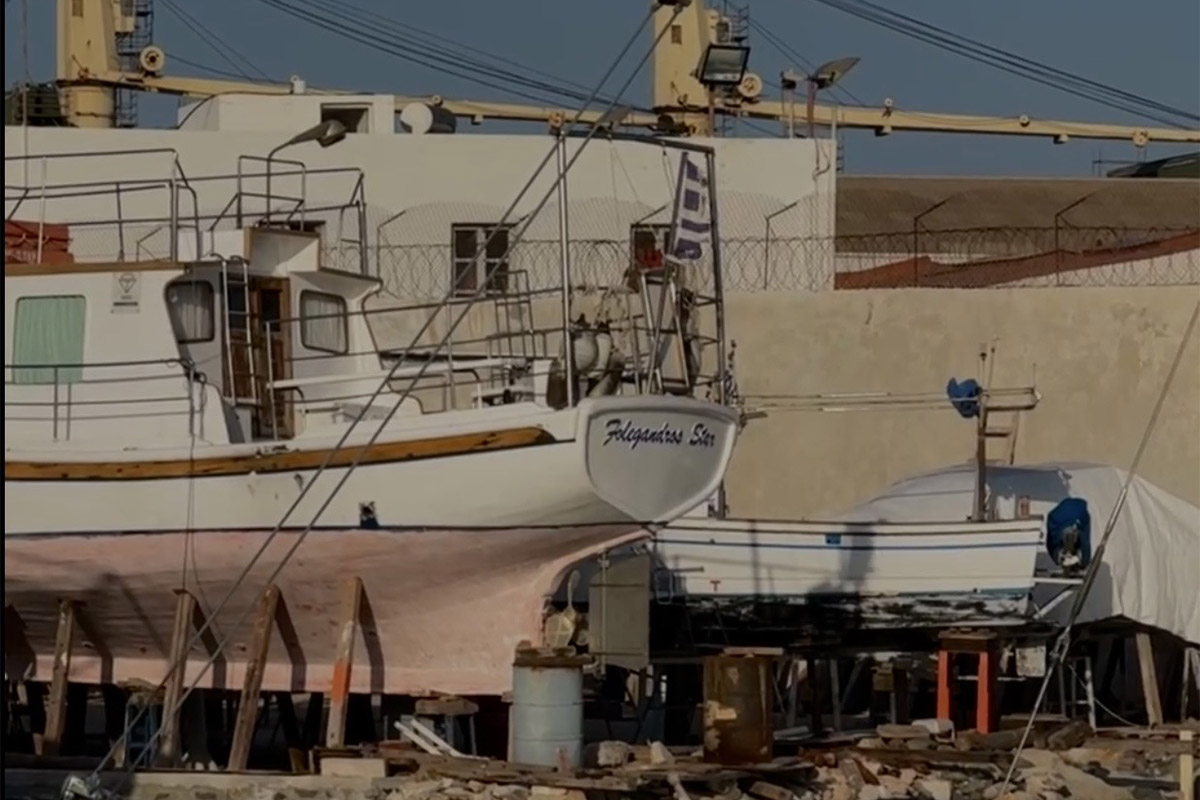
The Neorion shipyard at the edge of Ermoupoli has been operating since 1861, and it remains one of the most active in Greece. Ships are repaired here. Hulls are cut and welded. The smell of metal and sea air is part of the texture of the city in a way that has nothing to do with tourism. The shipyard employs hundreds of people. It contributes to the rhythm of daily life in ways that visitors only gradually become aware of.
This matters because it gives Syros a quality that purely touristic islands cannot have — the quality of being a real place that does real work. The harbor at Ermoupoli is not a stage set. It is a working port that has happened, additionally, to develop into one of the most beautiful urban waterfronts in the Aegean. The presence of the shipyard, the sound of it, the men who work in it and live in the surrounding neighborhoods, are part of what makes the island feel grounded in something other than its visitors.
The thread that connects them
Music, sweets, ships. At first glance, an unrelated trio.
Look more carefully and the pattern emerges. All three are crafts that arrived from elsewhere and were transformed by the specific conditions of this island. Rebetiko came from the cafés of Asia Minor and Piraeus and was carried back, in the genius of Vamvakaris, to a Syros that shaped it. Loukoumi came from Chios and was changed by Syros water. Shipbuilding came from a Greek maritime tradition that found, in this particular harbor, the right combination of geography and labor and ambition to flourish for two centuries.
What Syros does well, in other words, is take what arrives and make it its own.
This is also, not coincidentally, what the island offers to the right kind of visitor. Not a packaged experience designed for a tourist demographic. The chance to encounter a place that has been doing what it does for long enough to be genuinely good at it, and to allow the visitor to be part of that, briefly, with the appropriate respect.
Connecting guests to that version of Syros — to the live music, to the workshops, to the parts of the island that have nothing to do with performance — is among the things that distinguishes a stay arranged by Syros Key from a holiday arranged by anyone else.
To find out what we can arrange for your time on the island, visit our Services page or write to us at info@syroskey.gr. Every inquiry is answered personally.