

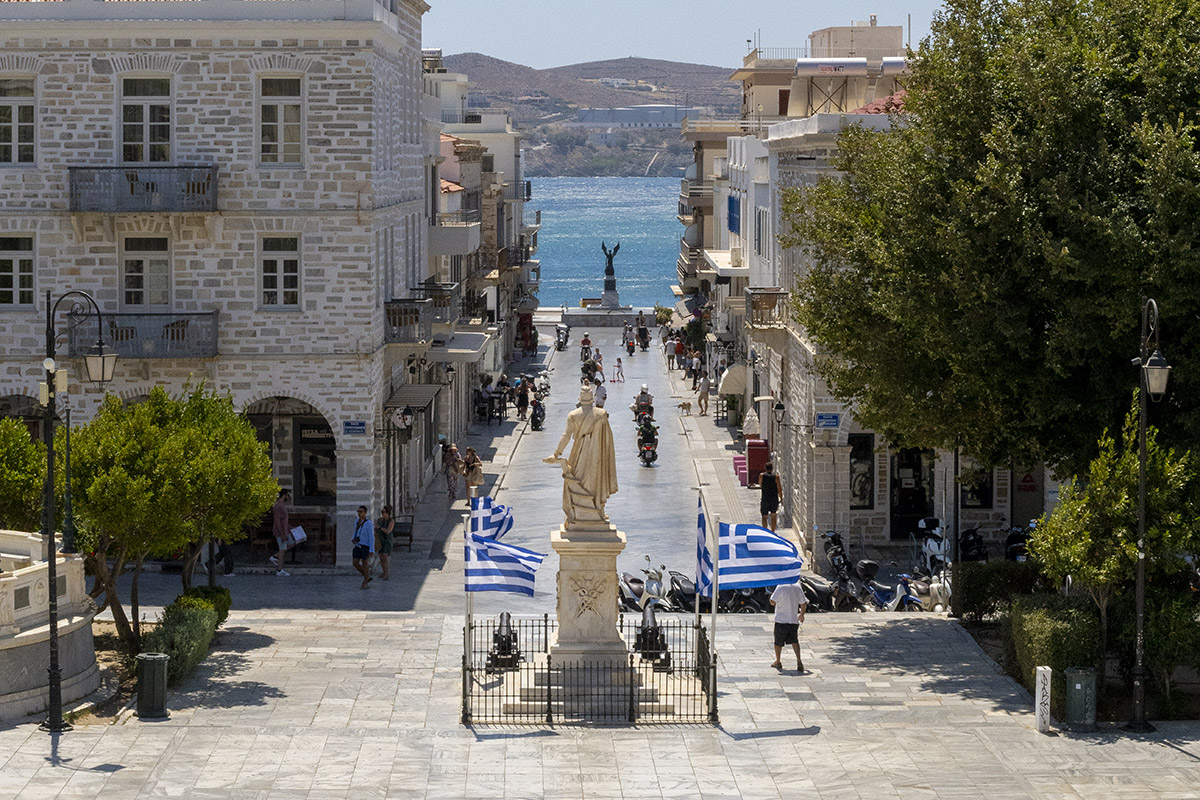
There are cities that grow organically, street by street, century by century, without plan or ambition. And then there are cities that are built with intention, by people who know exactly what they are doing and why. Ermoupoli is the second kind.
Founded in the early nineteenth century by Greek refugees from Chios and Psara, the city rose from an almost empty harbor into the most important port in the entire country within a single generation. At its peak, Ermoupoli was the wealthiest city in Greece. More ships passed through its harbor than through Piraeus. More goods were traded here than anywhere else in the Aegean. The people who built this city were merchants, shipowners and craftsmen who had lost everything and decided, with extraordinary determination, to build something that would not be easily lost again.
What they built has outlasted everything.
A city that refused to disappear
Walking through Ermoupoli today, the scale of what was built here is immediately apparent.
The neoclassical mansions that line the upper streets were not the homes of minor merchants. They were statements. Facades of dressed stone, wrought iron balconies, interior frescoes that would not look out of place in a Venetian palazzo. The city’s founders understood that beauty is a form of permanence, and they invested in it accordingly.
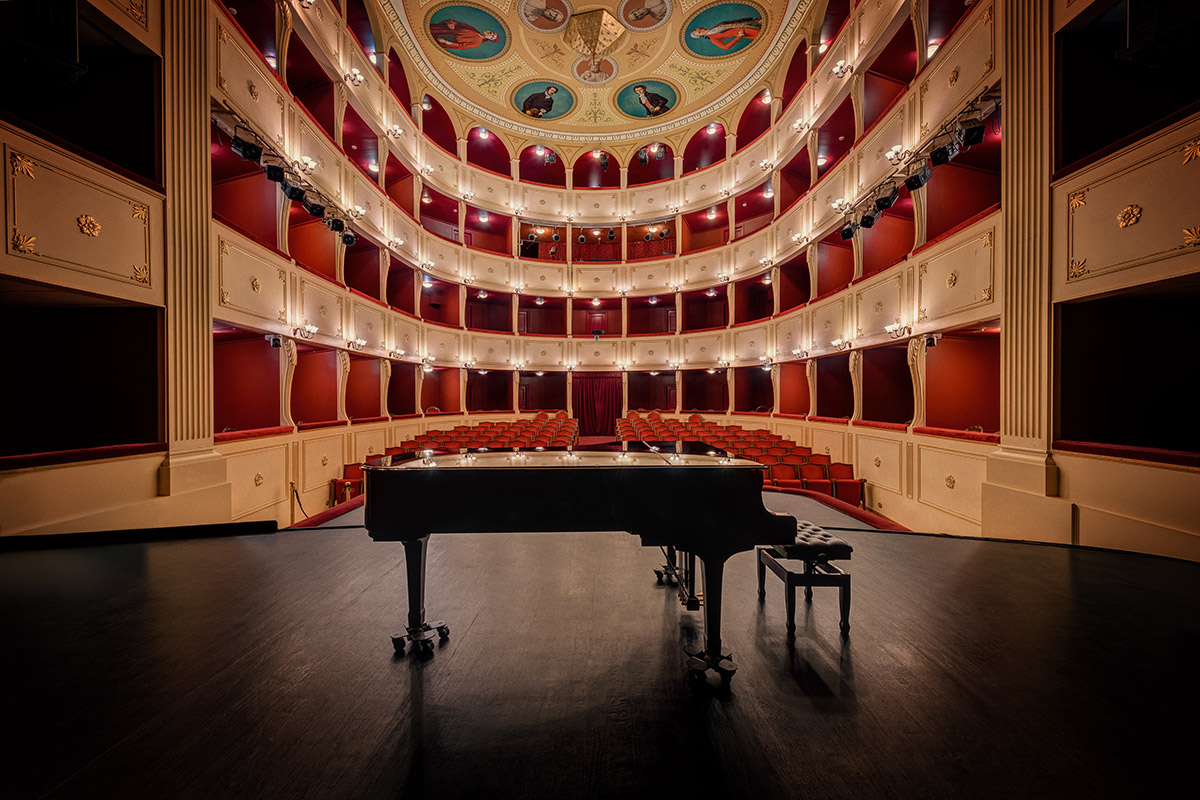
At the center of everything stands the Town Hall, one of the finest neoclassical buildings in the Mediterranean, facing a marble-paved square that fills each evening with locals who have been gathering here, in one form or another, for generations. Behind it rises the Apollo Theater, a miniature La Scala that was completed in 1864 because the citizens of Ermoupoli believed they deserved an opera house. Not hoped for one. Believed they deserved one. That distinction matters.
Furthermore, the streets that connect these landmarks are themselves remarkable. Ermoupoli is one of the very few Greek cities where the pavements are marble, worn smooth by two centuries of footsteps, and where the urban fabric has survived largely intact. There are no brutalist intrusions, no concrete towers interrupting the roofline. The city looks, in its bones, more or less as it did when it was at its most powerful.
What most visitors miss
The parts of Ermoupoli that stay with you are not, generally, the ones that appear in photographs.
They are the small things. The covered market near the port where the same families have sold vegetables and cheese for decades. The kafeneion on a back street where the morning light comes through a window at an angle that feels arranged, though it is not. The stairways that connect the upper neighborhoods to the waterfront, steep and uneven and entirely without handrails, used daily by elderly residents who have climbed them ten thousand times.
They are, additionally, the neighborhoods that most visitors never reach. Vaporia, the district of the ship captains, where the grandest mansions sit directly above the sea, their gardens cantilevered over the water. The Catholic quarter around the hilltop church of San Giorgio, where a distinct architectural language reflects three centuries of coexistence between two faiths on one small island. The industrial waterfront to the north, where the shipyard still operates and the smell of salt and steel reminds you that this city was built on labor, not leisure.
None of this is hidden, exactly. But all of it requires knowing where to look.
The city as context for a stay
Ermoupoli is not, in the end, a city you visit and then leave. It is a city you use as a base for understanding an island that rewards understanding.
The morning walk to the harbor for coffee. The afternoon that disappears into the market and the side streets. The evening that begins at the square and moves, at some point, to a table somewhere in the upper town with a view that justifies the walk up. These are not activities in the tourist sense. They are the rhythm of a place, and the rhythm is what you come for.
Experiencing Ermoupoli in Syros properly means having the time to let this rhythm find you. It means arriving without a fixed schedule, knowing that the schedule has already been taken care of, and that the city is therefore free to do what it does best, which is to reveal itself slowly, generously, to anyone patient enough to stay.
To plan your stay in Ermoupoli and across Syros, visit our Services page or write to us at info@syroskey.gr. Every inquiry is answered personally.