


Syros is not just another island. It is an architectural paradox that challenges everything you thought you knew about Cyclades. Two hills, two denominations, and two entirely different worlds “speak” to each other across the harbor. On one side stands the aristocratic Ermoupoli, with its neoclassical grandeur and marble-paved squares. On the other, the medieval Ano Syros, with its fortress-like character and labyrinthine alleys. This article explores this unique coexistence through three core pillars that define the island’s split personality.
The Neoclassical Port City (Ermoupoli)
Ermoupoli, the “Grand Dame of the Cyclades,” is a city that was built to be seen. Established by refugees from Chios, Psara, and Crete following the 1821 War of Independence, it wasn’t designed to hide from pirates. Instead, it was built to showcase wealth, enlightenment, and maritime dominance.

-The 19th-Century Radiance
Walking through Ermoupoli feels more like strolling through a European capital. Perhaps a sun-drenched version of Vienna or Trieste than being on an Aegean island.
- Miaouli Square & the City Hall: The heart of the city is a vast, marble-paved plaza. Dominating the space there is the City Hall, a masterpiece by the famous architect Ernst Ziller. This building is a symbol of power, featuring a monumental staircase and grand proportions that reflect the island’s golden age as the primary port of Greece.
- The Apollo Theatre: Often called the “Miniature La Scala,” this theater was built in 1864. It is the living proof that Syros was (and remains) the cultural lighthouse of the Aegean. To this day, it hosts world-class opera and theater, maintaining an uninterrupted link to its sophisticated past.
- Vaporia District: This is arguably the most photographed spot on the island. The mansions of captains and merchants “hang” directly over the sea with a breathtaking majesty. Here, the typical Cycladic white is replaced by ochre, terracotta, and marble, telling a story of cosmopolitanism and high-society living.
The Medieval Fortress (Ano Syros) – The Ancient Labyrinth
In direct contrast to the “open” and extroverted Ermoupoli stands Ano Syros. Perched high on the neighboring hill and established in the 13th century by the Venetians, it is a fortified settlement designed for survival during the turbulent Middle Ages.
-The Labyrinth of Protection
In Ano Syros, architecture was never about display. It was about defense.
- Labyrinthine Alleys: The streets are so narrow that two people can barely walk side-by-side. They were designed as a maze to confuse invading pirates. Low doorways, stone arches, and continuous stairs create a sense of mystery, transporting you directly back to the medieval era.
- San Giorgio (Saint George): At the very peak of the hill sits the Catholic Cathedral. For centuries, Ano Syros was the stronghold of Catholicism in Greece (the “Pope’s Island”). The presence of Jesuit and Capuchin monasteries gives the settlement a distinct, spiritual, and somewhat somber atmosphere compared to the bustling port below.
- The Sound of Markos: As you climb the stone steps, the aura of Markos Vamvakaris, the “Patriarch of Rebetiko,” is everywhere. This raw, urban music was born here, among the humble but spotless stone houses, creating a cultural counterpoint to the opera being performed in the Apollo Theatre down the hill.
The Harmony of Contrast – Where Two Eras Meet
The most impressive element of Syros is not one hill or the other, but their harmonious coexistence. It is the exact point where the Middle Ages meet the Enlightenment.
-Two Hills, One Soul
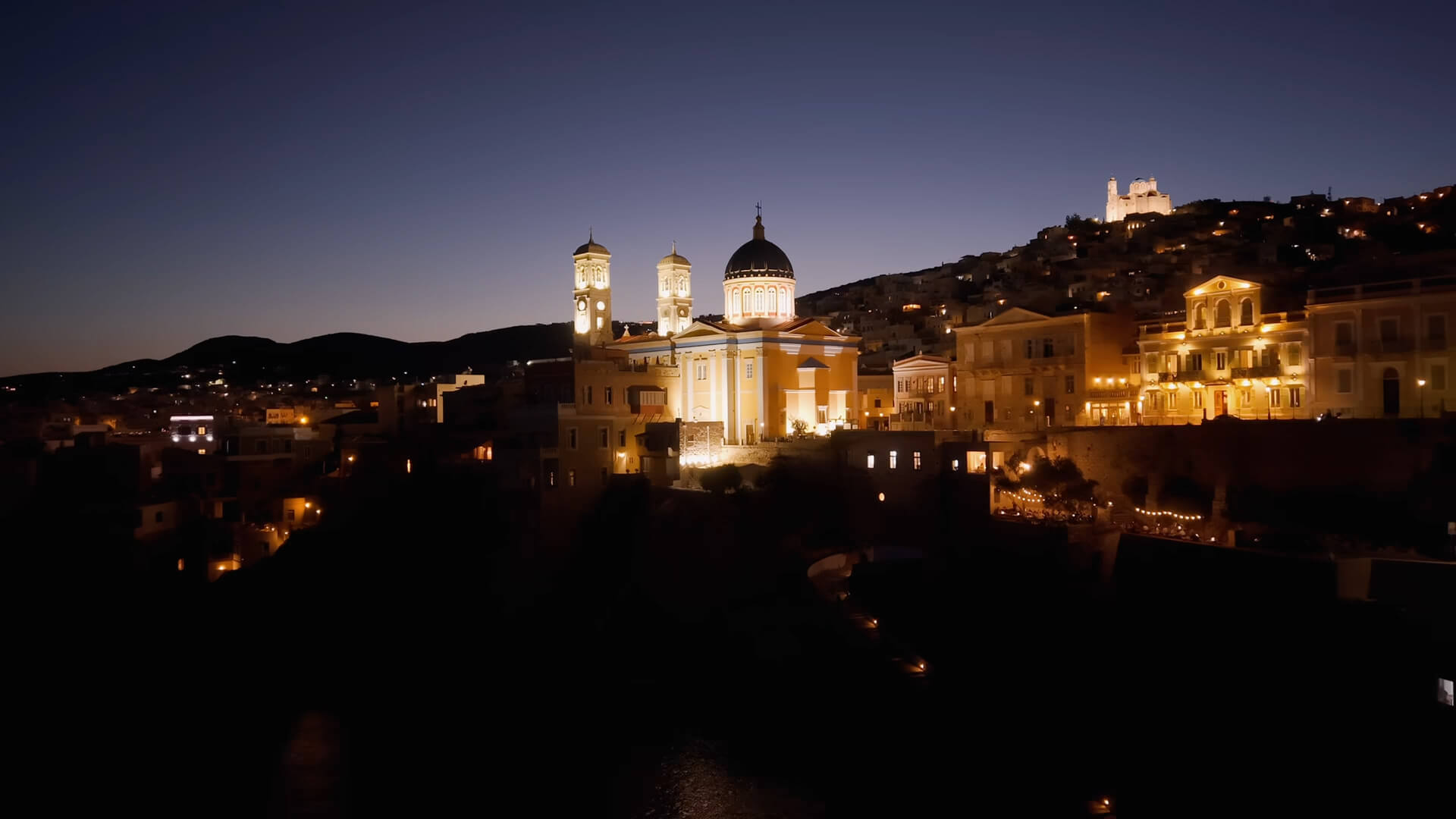
From the harbor, the view is hypnotic: on the left, the hill of Ano Syros with the Catholic San Giorgio at the top and on the right, the hill of Vrontado with the Orthodox Cathedral of the Resurrection.
- Religious Reconciliation: Syros is one of the few places in the world where Catholics and Orthodox Christians celebrate Easter together, regardless of the official calendar date. This “harmony of contrasts” is what makes Syros stand out from every other place in Greece. It is a masterclass in social and religious tolerance.
- The Urban Transition: The city of Ermoupoli slowly “climbs” toward Ano Syros, bridging the gap between fortress-like isolation and urban extroversion. You can literally feel the transition from marble to stone, from the 19th century back to the 13th, as you walk upward.
- The View of the Duality: To truly feel this harmony, one must stand at the San Giorgio Cathedral at dusk. From there, you see the flickering lights of neoclassical Ermoupoli laid out like a carpet at your feet, while behind you, the shadows of the medieval fortress remain steadfast and silent.
Syros does not force you to choose between the Medieval and the Neoclassical. It invites you to inhabit both. It is an island where you can start your day with an espresso in a 19th-century marble square and end it with a glass of tsipouro in a medieval alley, listening to the gritty strings of a bouzouki.
This duality is the true identity of Syros. It is the place where two different eras met and decided to coexist, creating the most charming and authentic “mosaic” in the Aegean. For the traveler who seeks depth, Syros is the ultimate destination—not because it is “pretty,” but because it is profoundly real.